Hedge or Dry-Stone Wall: Two Different Edges
Hedge or dry-stone wall: see how each shapes a field’s edge through line, texture and enclosure, and choose the boundary that suits the landscape.
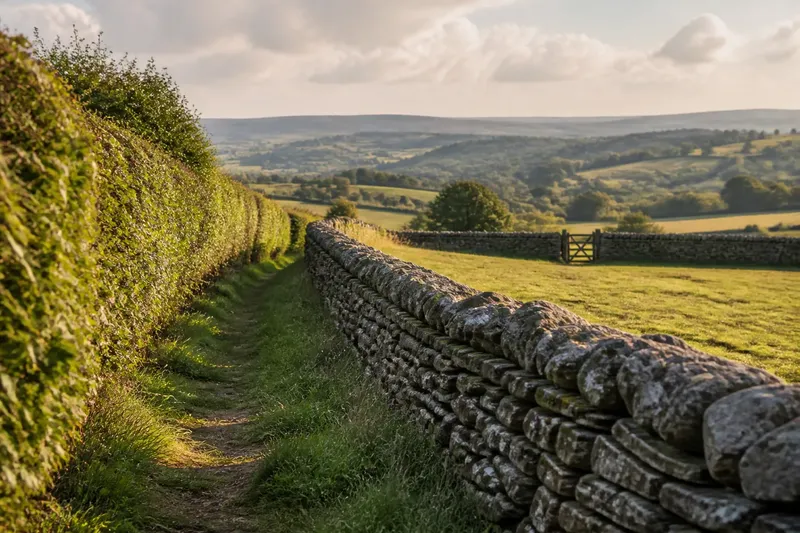
The common mistake with a hedge or dry-stone wall is to treat them as interchangeable ways to mark a field. Both draw a line across the land, but the line costs the view something different: a hedge softens and thickens it, while a wall makes it crisp and legible. Notice that distinction before deciding which edge belongs in a rural setting.
Each boundary has a visual character formed by its material, height, continuity and relationship to the ground around it. The question is not simply which looks more traditional. It is how the edge changes what you see across the field and how enclosed the place feels from beside it.
Hedge or dry-stone wall
A hedge is a living mass of branches and leaves, even when carefully clipped. Its outline can be rounded, uneven or cut into a level face. A dry-stone wall is built from stones set without mortar; its profile depends on the size and arrangement of those stones, often broad at the base and narrower towards the top.
That difference creates two kinds of boundary line. A wall tends to read as a distinct edge, with a visible top and a strong base. A hedge reads as a band: its outer surface may be clear, but the foliage gives the boundary thickness and a softer transition into the field.
Think of the contrast between a pencil line and a woollen cord. Both mark a route, but one looks fine and exact while the other has body and texture. In a landscape, the wall is not always narrow and the hedge is not always soft; the analogy is useful for seeing how sharply each separates one side from another.
Line across the land
Follow the boundary with your eye from one end to the other. A dry-stone wall often directs attention along its top course, particularly where it crosses open ground. Its repeated horizontal stones can make a long, steady line feel deliberate. Changes in the wall’s height or direction are easy to read because the top edge and stacked face remain visible.
A hedge can make a similarly continuous line, but its outline is less exact. A clipped hedge may create a formal-looking sweep; an uncropped one can rise and fall with the plants. Gaps, protruding branches and seasonal growth break the line into smaller shifts. That variation can help an edge sit comfortably in a loose landscape, but it can also make a field boundary seem less defined from a distance.
The ground matters as much as the material. A wall following a slope shows the terrain through changes in its courses and height. A hedge can mask small changes in ground level, so the field appears to meet a single band of green. Neither effect is automatically better: choose which one supports the character you want the land to show.
Texture and seasonal change
Stone offers a steady surface of edges, joints and colour differences. The texture is visible in winter as well as summer, although light and weather alter its appearance. Rough, irregular stones give the wall a broken pattern; more consistently shaped stone makes the face feel ordered. Look at the wall from the path and from across the field, because details that are strong close up can merge into a simple line at a distance.
A hedge changes more conspicuously with the seasons. Leaves can turn the boundary into a dense green screen, then fall to reveal branches and glimpses through the stems. Flowers, berries or fresh growth may add colour, but the effect depends on the plants present and the time of year. A hedge therefore brings movement into the view: its appearance shifts while the position of the boundary stays put.
That shift affects how much of the surrounding landscape remains visible. A leafy hedge may conceal a nearby lane or divide a field into smaller visual rooms. A bare hedge can feel more open without losing its outline. A wall usually gives a more consistent view through the year, though its height and width still determine how much it blocks from a particular viewpoint.
The sense of enclosure
Enclosure is not only about whether a boundary blocks sight. A hedge can feel close because its foliage forms a continuous screen beside a path. Its uneven crown may also make a route feel sheltered. A low wall, by contrast, may mark ownership clearly while leaving much of the field visible above it. A taller wall can feel more enclosing, especially where it runs close to a narrow track.
Distance changes the effect. Seen from within a field, a boundary close to the viewer can feel like a strong frame, while a far hedge may read as a soft edge to the whole scene. A wall can pull the eye towards a gate or corner because its firm line points along the boundary. Check the view from the places people actually approach, pause or look out from, rather than judging the edge from only one position.
Imagine a small pasture beside a narrow walking path, with an open view beyond. If the edge is a dense hedge, a person on the path may see a close green screen and only fragments of the pasture. If it is a low dry-stone wall, the field remains visible above the stones and the boundary can guide the eye towards a gate. The observable difference is not just colour: one edge screens the view, while the other marks it without closing it off.
Choosing the right edge
Start by describing the boundary’s job in visual terms. Should it blend into a leafy edge, hold a clear line across open land, screen an adjoining view or let the field remain visible? Then consider how that appearance relates to nearby materials and forms, rather than selecting the boundary in isolation.
- For a soft outline: a hedge can make a hard division feel less abrupt, particularly where the surrounding landscape already has generous vegetation.
- For a readable route: a wall’s firm top line can lead the eye along a path, field edge or approach to a gate.
- For changing views: a hedge’s foliage creates different levels of screening as it grows and sheds leaves.
- For visible ground shape: a wall shows its changes in height and direction, while a hedge can visually smooth some unevenness.
- For a strong sense of boundary without a solid screen: a low wall can define an edge while leaving the land beyond in view.
These are visual tendencies, not fixed rules. A closely trimmed hedge can look very controlled, and a wall made from varied stone can feel irregular and relaxed. Look at existing boundaries nearby: their scale, colour and pattern often explain why one type belongs in a particular place better than a general idea of country style can.
Questions about boundaries?
Which boundary looks more open?
A low dry-stone wall usually leaves more of the field visible above it. A hedge can also feel open when it is low or sparse, but leafy growth may screen the view.
Does a hedge always look softer?
No. A tightly clipped hedge can have a crisp, controlled outline. The softness comes from its foliage and natural variation, not simply from being a living boundary.
Can a dry-stone wall feel enclosing?
Yes. Height, width, nearby buildings and the narrowness of a path all affect how enclosing it feels. A wall can also create a strong visual division even when the view above it stays open.
Which edge suits a sloping field?
Either can follow a slope, but they show it differently. A wall makes changes in level visible along its courses, while a hedge can read as a more continuous band across the ground.
Read the whole boundary
Before settling on a hedge or dry-stone wall, look along the edge in both directions and from more than one distance. Notice where the line begins, whether it breaks at an entrance, what lies behind it and how the view changes when you move beside it. Those observations reveal whether the boundary should frame, screen or simply mark the field.
The most fitting choice is the one whose line, texture and enclosure make sense with the landscape around it. A hedge or dry-stone wall is not just a border between two pieces of ground; it is part of the view, and its visual weight should feel at home there.